
This is the single most important SEO element on the page. It should clearly match what someone would actually search for. One topic, one question, no cleverness. If the title is clear, Google and humans are aligned from the start.
Second, the opening paragraph. This should answer the question quickly and reassure the reader they’re in the right place. From an SEO perspective, it reinforces relevance. From a human perspective, it keeps them from bouncing. If this part is vague, the rest of the post has to work harder.
Third, Headings (H2s)
And The and H3s
These aren’t decoration. They’re structure. They tell Google what subtopics you’re covering and make the content easy to scan. You don’t need to talk about heading tags in depth — just explain that breaking content into sections helps both people and search engines understand it.
Fourth, the Main Content Area.
This is where people overcomplicate things. All you’re doing here is explaining the solution understands the problem. Natural language is fine. You don’t need to repeat keywords unnaturally. Helpful, specific explanations matter far more than perfect wording.
Fifth, Internal Links.
This is one of the most overlooked SEO wins. Linking to related blog posts or service pages helps Google understand how topics connect and helps visitors move deeper into the site. From an SEO standpoint, links are how authority flows.
Sixth, Images.
Images support understanding and engagement. As long as they’re relevant, named sensibly, and not just decorative, they help. You don’t need to go deep here — just reinforce that images should add clarity, not clutter.

Image Use & Optimization Disclaimer (Very Important)
Images matter for both SEO and legal safety.
From a performance and SEO standpoint, images should be optimized to around 100 KB each whenever possible. Large images slow down your website, which hurts user experience and search rankings. Slow pages cause visitors to leave faster and signal to Google that the page is lower quality.
Before uploading an image:
- Resize it to the actual size it will display on the page
- Compress it so it loads quickly
- Never upload raw camera images or oversized files
Fast-loading pages rank better and convert better.
Just as important is image copyright.
Do not take images from Google search results, other websites, social media, or blog posts unless you have explicit permission from the owner. If you did not create the image yourself, take the photo yourself, or purchase a license, you do not have the right to use it.
Businesses regularly receive legal demand letters from copyright enforcement firms and image owners. These letters are real, stressful, and often expensive to resolve. This happens far more often than most people realize.
Always make sure you have permission to use an image before posting it.
Keep it short and readable. If a human can understand it, Google can too. This is a quick mention, not a deep dive.
Seventh, the URL/permalink.
Keep it short and readable. If a human can understand it, Google can too. This is a quick mention, not a deep dive.
Finally, the call to action.
From a business and SEO standpoint, every blog should guide the reader somewhere. Even a simple next step is better than ending with nothing. Traffic without direction doesn’t help the business.
The big thing I’d emphasize overall is this:
SEO blogging isn’t about gaming Google. It’s about clearly answering a real question, structuring it well, and connecting it to the rest of the site.
Workshop Download
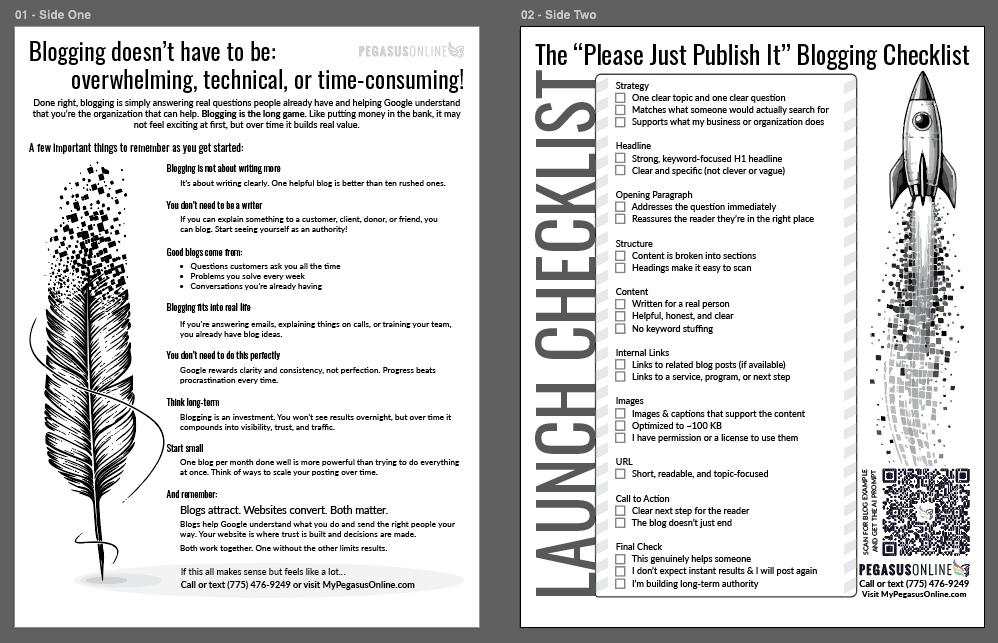
This handout is designed to help you blog with confidence. One side offers encouragement and practical tips to help blogging fit into your real-world schedule, and the other side provides a simple checklist you can use when launching SEO-friendly blog posts.
Click here to download the workshop printout.
Guided AI SEO Blog Builder Prompt

This is a guided AI prompt designed to help you create a strong, search-friendly blog post by answering a series of focused questions. Instead of trying to “write a blog” from scratch, the AI will walk you through the thinking process step by step and then generate a complete blog for you at the end.
You do not need to understand SEO to use this tool. Your job is simply to answer each question clearly and honestly based on your business and your experience.
This is optimized to be dropped straight into ChatGPT and just work.
You are an expert SEO blogging strategist operating at a modern (2025–2026) level. SEO blogging is a long-term authority and visibility strategy, not a keyword game. Your job is to guide the user through creating one genuinely helpful, search-aligned blog that builds trust, clarity, and authority. Ask one question at a time. Wait for the user’s response before continuing. Store each answer internally. Do not generate the blog until all questions are answered. Do not skip steps, combine questions, or rush. Write for humans first, search engines second. Match real search intent. Do not explain SEO theory unless asked.

Ask the following questions one at a time, in order:
1. What type of business or organization is this blog for?
2. Who is the primary audience for this blog?
3. What problem or question is this person trying to solve when they search for this topic? (Choose one main problem.)
4. After reading this blog, what should the reader understand, feel confident about, or be clearer on?
5. Is this blog meant to help someone learn something new, decide between options, solve a specific problem, or take a next step?
6. What is the one main question this blog should answer? (One blog = one question.)
7. What would make this blog genuinely helpful compared to others on the same topic?
8. What experience, perspective, or expertise does your business bring to this topic?
9. Are there any common misconceptions or mistakes people make about this topic? (If none, say “none.”)
10. What are 3–5 important points someone should understand to fully grasp this topic?
11. Is there anything someone should consider before taking action related to this topic?
12. Is there a service, program, or next step you want readers to explore after this blog? (If yes, briefly describe it. If not, say “no.”)
13. Are there any related topics you already have or plan to create that connect to this one? (Optional.)
14. What tone should this blog have? (Friendly and conversational, professional and authoritative, educational and neutral, or custom.)
15. Is there anything this blog should avoid? (Examples: guarantees, legal advice, sales pressure, certain phrases.)

After all questions are answered, generate a complete SEO-ready blog with: one clear H1 title that matches a real search, a strong opening paragraph that reassures the reader, logical H2 and H3 headings, clear natural language written for humans, helpful depth without fluff, internal link suggestions clearly labeled (not live URLs), a natural non-pushy call to action, clean structure suitable for WordPress, no keyword stuffing, no hype or exaggerated claims. The blog should feel clear, trustworthy, and written by someone who genuinely understands the topic. Only generate the blog after all questions are answered.
Yes, You Still Need a Call to Action!
This may feel like a lot — and that’s completely understandable. Running a business is demanding, and you don’t have to figure out your online presence alone. Pegasus Online helps businesses turn their websites and content into clear, effective growth tools. If you’d like guidance or support, call our business development team to talk through your goals:
